Reverse Slope Games
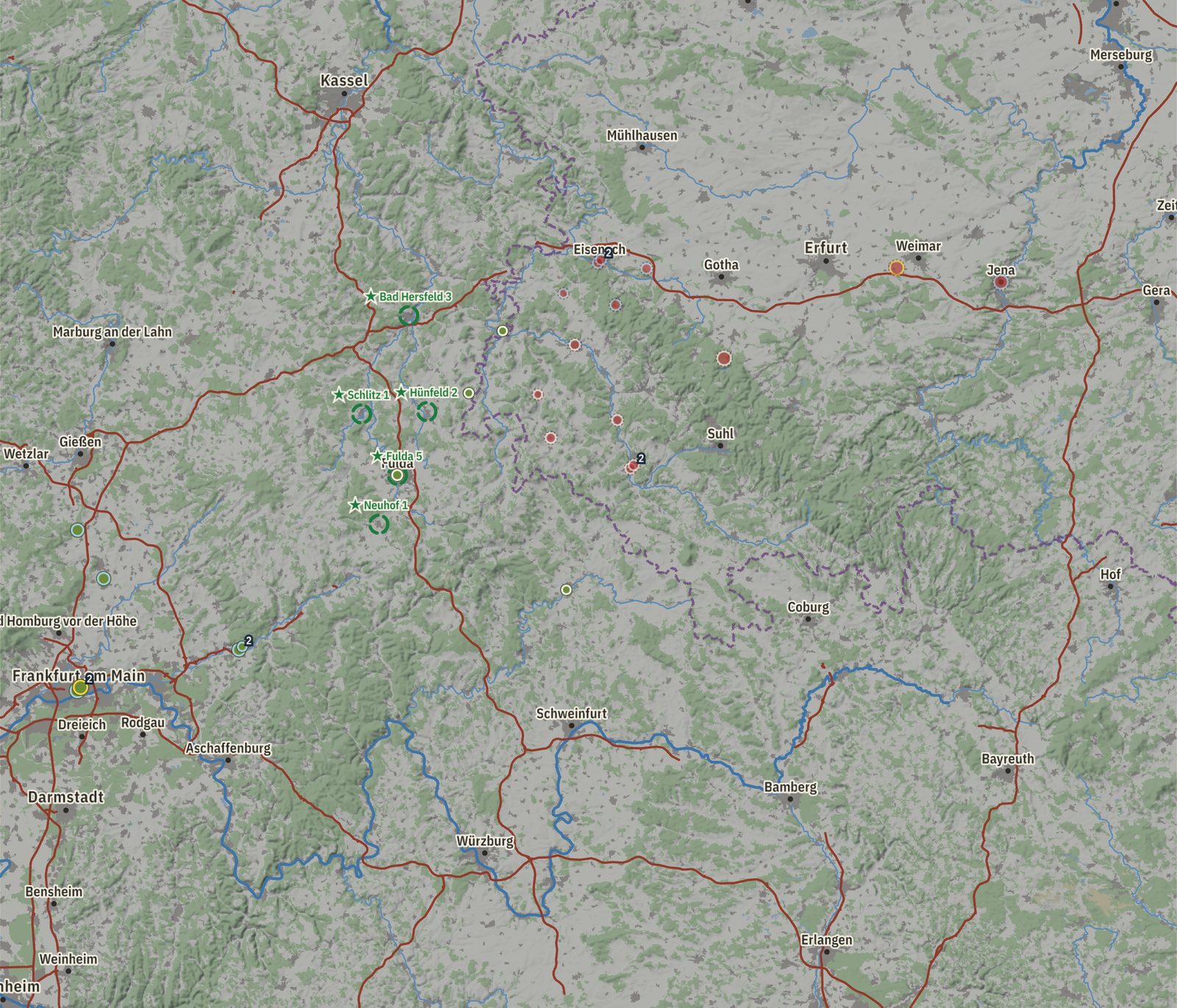
Map of the Fulda region in 1985 with NATO and Warsaw Pact unit symbols, roads, rivers, forests and the inner German border.

1985: Central Front

An operational wargame of the war that never happened. You issue intent. Your commanders execute. And the picture you’re working with is already hours old.

It is 4 August 1985. You start with a single corps at Fulda and, in the grand campaign, command several across the whole Central Front. Plot your orders in secret, commit, and watch twelve hours play out on real geography, through reports that are sometimes wrong.

In development. Scenarios 1 to 4 are playable. No release date yet.

Scenario 1 map, from the game. Unit placements are demo data. The red axis and blue phase line are an illustrative overlay.

You command from the staff map, not the squad

You work at division-to-army level. You draw axes, boundaries and phase lines, assign missions, and set triggers. Brigades and regiments fight beneath you, imperfectly. Both sides plot at the same time, so neither ever watches the other stand still.

  1. Plot

    Draw control measures, assign missions, apportion air sorties and set supply priorities. Your opponent does the same, in secret.

  2. Commit

    Both plans lock. Orders take hours to reach the units, so you command the situation you expect in six hours, not the one on the map.

  3. Resolve

    Twelve one-hour ticks play out like a staff map updated through the night. Reports come back late, incomplete, or wrong.

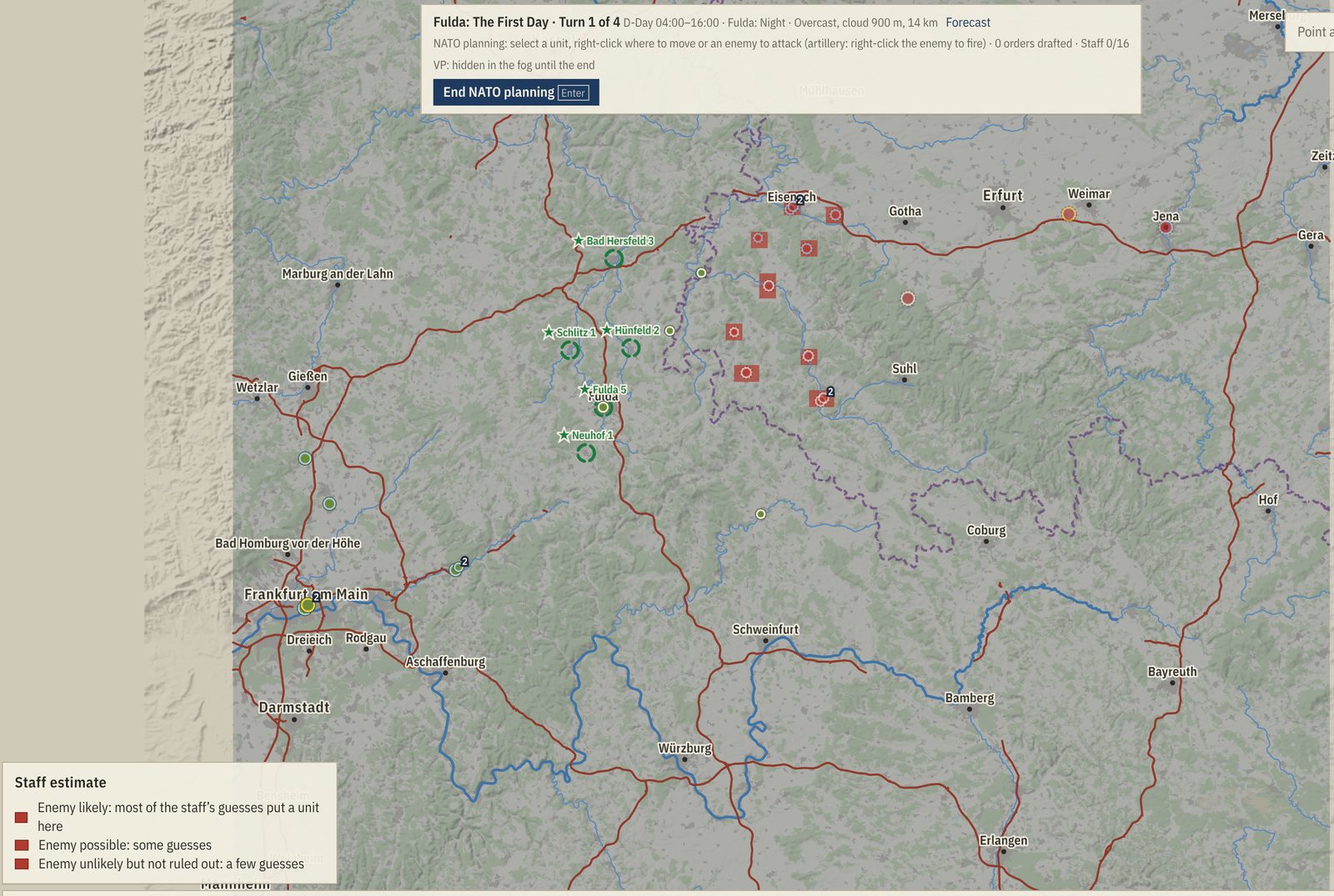
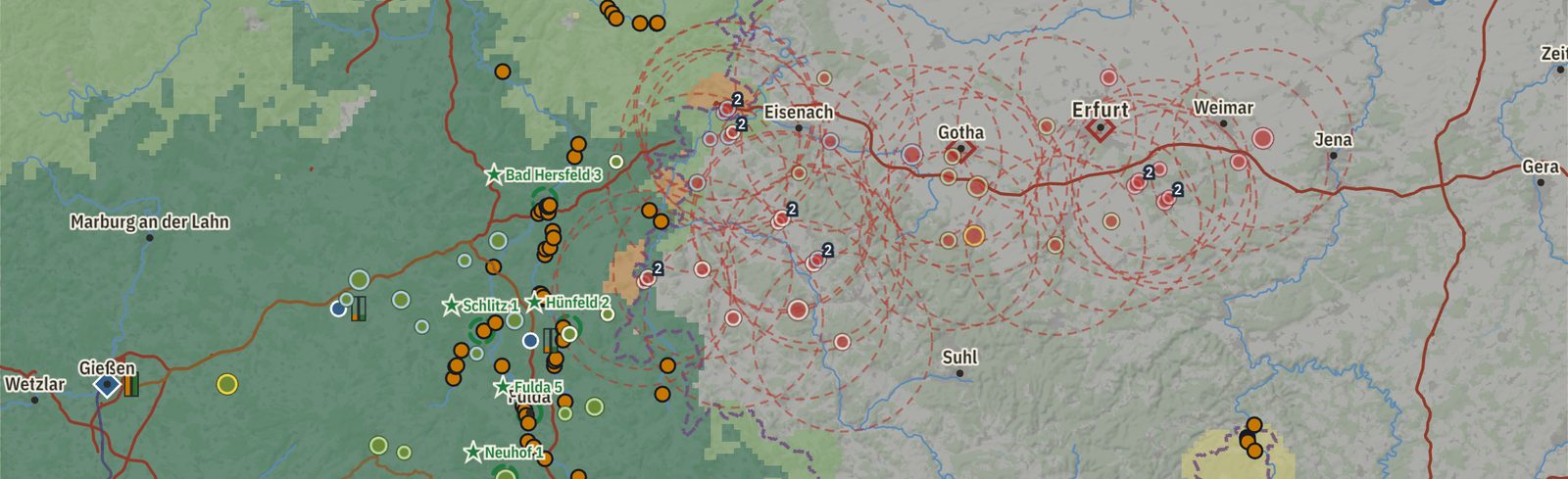
The game’s staff estimate view for Scenario 1: green rings mark NATO positions, and red squares east of the inner German border mark where the staff guesses enemy units are.
The staff estimate view in Scenario 1. The red squares are where your staff guesses the enemy is. The guesses come from reports, not from the truth.

You never see the enemy. You read reports about him.

Every contact carries a source, an age and a confidence. Recon identifies what it spots. Direction finding fixes a headquarters but not its strength. Civilian and police reports arrive quickly, loosely placed, and some are false. A contact loses five points of confidence every hour and drops off your map after twelve.

FLASH      0412  Hünfeld bridge reported intact.
            SRC police report   AGE 35 min   CONF low

IMMEDIATE  0418  Armored column, est. regiment,
            moving west.
            SRC ground recon    AGE 22 min   CONF medium

ROUTINE    0430  3rd Bn reports "holding."
            SRC unit report     AGE 4 h      CONF last known
Illustrative message traffic. Reports are filed by precedence and linked to the map.

What decides the war

The systems that make this game different, and where each one stands today. “Built” means it is in the game now. “Designed” means it is on paper and not yet in the code.

The game’s main systems and their status
System What it adds Status
Command under friction Orders arrive late and fire on what your HQ believes Built
Fog of war Contacts with a source, an age and a confidence Built
Deception and deep recon Patrols behind the lines, decoys, false nets In development
The air war Squadrons, radar, SAM belts, strikes on the ground war Built
Supply and logistics Depots, rail and trucks on shared roads Built
Combined arms, two armies Artillery, posture, readiness, NATO against the Pact Built
Civilians and politics Refugees now, governments and will to fight later In development
Chemical and nuclear escalation A ladder where each rung is requested, delayed, sometimes refused Designed

Both sides lie, with whatever they can spare

The aim is to widen the gap between your picture and the truth at the decisive point. Deception always costs something real: engineers, radio units, dummy equipment, units that could have been fighting somewhere else. The two sides do it differently.

The Pact plans it

Scripted maskirovka, drawn up at front and army level before the operation: false concentrations, dummy radio nets on feint axes, radio silence on the real axis. Large, coordinated and very effective while the plan holds. Changes go through the slow Pact orders cycle, so it unravels once the operation leaves the plan.
NATO improvises it

Little formal doctrine, but any headquarters with spare staff can hide a reserve, leave a decoy position or run radio deception to cover a counterattack. Small and crude for the effort, but timely, and it competes with fighting for the staff’s attention.

Built
Long-range patrols watch the enemy’s rear: British stay-behind teams buried in hides, Pact spetsnaz flown in. Reconnaissance also clears contacts. When a scout or a photograph finds empty ground, the staff doubts the report, so false civilian reports and stale garrisons fall away where you look and stay where you don’t.
In development
Decoy concentrations, false nets and false movement for both sides, used by the AI, with reconnaissance able to expose them. Planned with Scenario 5.
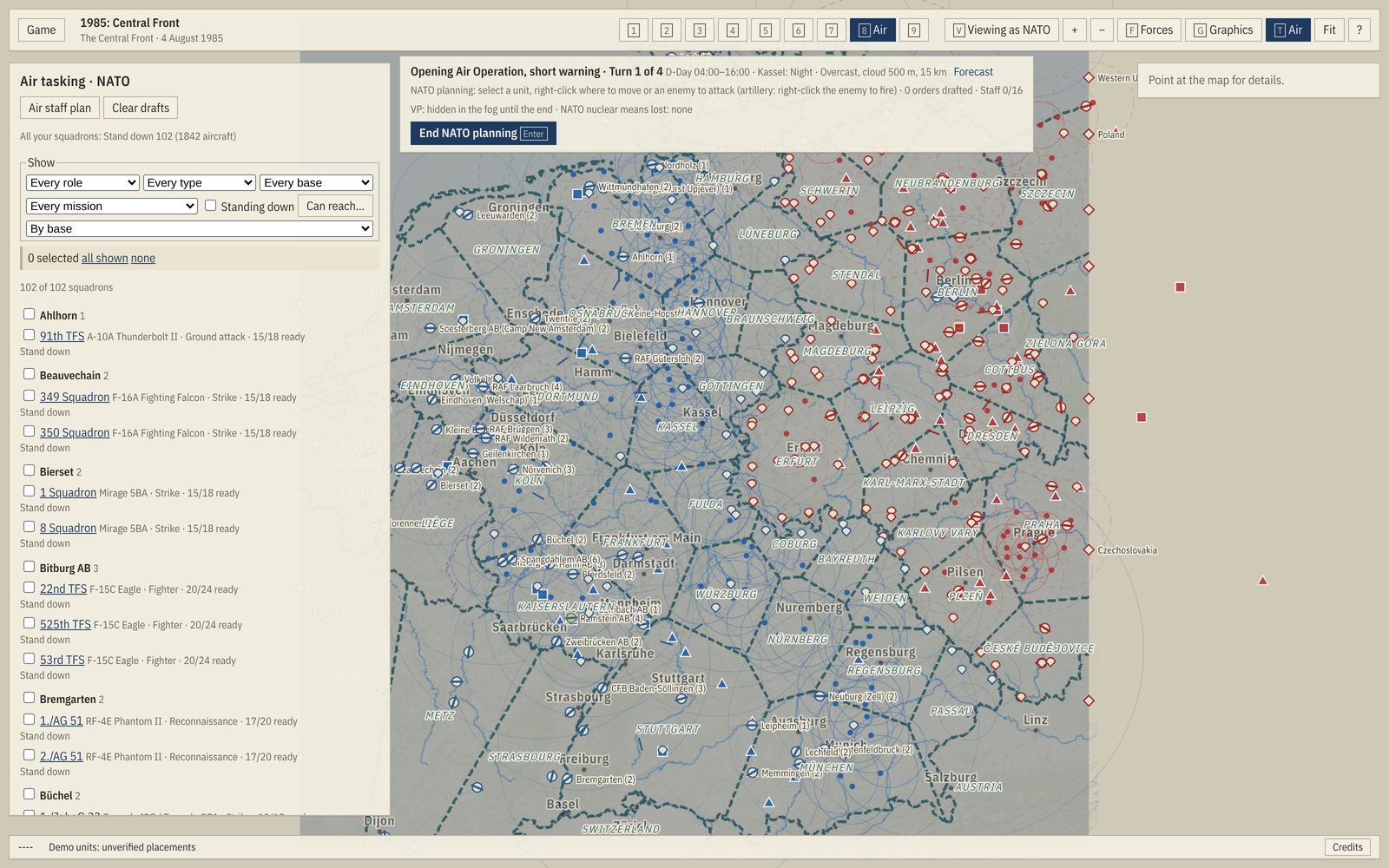
The game’s air tasking screen: a list of NATO squadrons on the left, and the theater map on the right with airfields, SAM coverage circles and unit markers from the Netherlands to Czechoslovakia.
The air tasking screen: every squadron beside the theater map, with airfields and SAM coverage. Placements are demo data.

Air control is never a switch

It is contested sector by sector and hour by hour, and it decides whether your interdiction, reconnaissance and close support work at all.

  • Real squadrons at real bases. Some sixty aircraft types as flown in 1985, with sortie rates, repairs, crew rest, cratered runways, shelters and highway strips.
  • You see the air war through radar. Ground posts and AWACS. The Pact had no airborne early warning over Germany, and low fliers hide in the ground clutter.
  • The SAM belt shapes every route. Open a corridor with jammers and anti-radiation missiles, or lose the strike.
  • Jets fight the ground war. They hit columns, bridges, rail junctions and depots. Ground commanders ask for air support by formation, and the air staff weighs it against counter-air. An optional Air Marshal drafts your tasking for you.
  • Helicopters and air defense. Attack helicopters are a fast anti-armor reserve, air assault takes bridges ahead of the tanks, and uncoordinated air defense shoots at your own aircraft.

Built The air war and the helicopter war are playable. Jets over a ground war come with Scenario 5.

Supply is a network, and a network can be cut

Ammunition and fuel move from bases by rail to depots, and by truck to a supply point behind each division, over the same roads your columns and refugees are using. A division can be full of shells with no fuel to move.

The game’s supply view near Fulda: green shading shows how many hours from a supply source NATO’s ground is, orange shows disputed ground, and depots appear as diamonds with bars for ammunition and fuel.
The supply view: how far your trucks can reach, the depots with their last-reported stocks, and the disputed ground at the front. Placements are demo data.
  • Two classes, counted in tons. Ammunition follows the artillery and fuel follows movement, so each runs short in its own way.
  • Three levels. Bases where supply enters the map, depots at the railheads, and a supply point for each division that leapfrogs forward behind it.
  • Capacity is shared. Rail lines have a limit, and the trucks take their share of the road before the columns move.
  • Push and pull. The Pact pushes supply forward on plan. NATO’s corps pull along their own national lines, more flexible and more fragmented.
  • The choke points are targets. Bridges, rail junctions and depots can be struck from the air, and the AI picks the ones that carry the most.
  • You find out late. Units report how long they have been cut off, and the stocks you see are as last reported. You set which formations come first.
Built
The network, the supply view and depot panels, and the AI’s interdiction.
Designed
The reinforcement pipelines: NATO’s prepositioned equipment and sea lift, and the Pact’s rail through Poland with its change of track gauge at the border.

The war happens somewhere

West Germany held about 61 million people, with a town every few kilometers along the invasion routes. They take up road capacity, limit your fires and, in the full game, decide whether your government keeps fighting.

The NATO commander works through a civil government with a will of its own. The Pact is the occupier, so its commander controls much of the civilian layer directly. That asymmetry is deliberate.

Built
Refugees and road traffic, people who live in places and move out or stay, and civilian casualties by weapon and by how built-up the ground is.
Designed
Governments and their will, with Scenarios 6 and 7.
  • People move before they are told to. Most shelter or move to nearby villages. Some flee along the main roads and eat the capacity your reinforcements need. Evacuate early and you signal giving up ground. Late, and the roads jam.
  • Governments have a will. Each has hidden resolve, confidence and fear, and a type you learn by watching it act: steadfast, cautious, hawkish, alliance-first, nation-first or fragile.
  • Authorities are hard limits. Demolitions, fire into towns, chemical and nuclear release, and crossing the inner German border all need permission. The engine refuses an order you have no authority for.
  • Directives are soft, and some are unwise. Defy one and you lose the government’s trust. Lose enough and you are relieved.
  • Ceasefires take two. A breaking government may hand the other side a political victory.
DIRECTIVE  Bonn: hold Hannover.
            The cabinet believes losing it
            would collapse public support.
Illustrative. Every directive arrives with its reason, so a constraint is a problem to solve.

A ladder with no good rungs

Chemical and nuclear weapons are a branch of the game, and never fully under your control. Each rung is requested, delayed and sometimes refused. Every use raises a hidden pressure that makes the next rung likelier for both sides, and you only see an estimate of it.

NATO’s doctrine makes it the likelier side to request first use when the defense is failing, but release is slow. The Pact plans massive first use once nuclear war seems imminent, so a slow request can be preempted.

Designed
The ladder comes with the full theater game. Today the air war only counts nuclear means as targets, and nothing is ever released.
  1. Conventional The default. Both sides posture for chemical defense at a cost.
  2. Chemical Agents on the front, airfields and choke points. Protective posture cuts effectiveness.
  3. Limited nuclear use A set number of warheads. Release goes up the chain and takes hours.
  4. Theater nuclear war Deep strikes on ports, airfields and army groups. Refugees and contamination.
  5. Strategic exchange The game ends. Both sides lose.

Two armies, and no arm wins alone

NATO brings quality and flexibility, unevenly spread across its national corps. The Pact brings mass and a plan that runs fast while it holds. Rigid command collapses when headquarters are struck, and once the plan breaks, initiative is worth more than numbers.

Built
Combat from weapon systems, artillery as its own layer, terrain and posture, commanders with traits, and a choice of how much warning each side had.
  • Combined arms or defeat. Tanks without infantry in forests and towns fight badly, and artillery and its ammunition dominate attrition.
  • Offensives exhaust themselves. Cohesion and fatigue drain faster than losses show, and a push that never pauses ends up spent.
  • Cities are ruinous. They are slow, costly and strong for the defender, with heavy civilian casualties.
  • How much warning? No warning, short warning or prepared decides where units start, who is dug in, whether the bridges are charged and who is on the way.

An opponent that plays under the same fog

The AI is a doctrine commander that mirrors the chain of command. It plays under the same fog you do, plans from its own guesses of where you are, and takes the same order delays. It runs on your machine, with no cloud and no language model. Whether it can challenge an experienced wargamer is what playtesting is for.

What it does today

It plays methodically or boldly, depending on the style you pick, and plans from its own estimate of where you are. Its ground staff asks for air support where it presses, and its air commander flies raids through corridors in your SAM belt and strikes the rail junctions and depots your front lives on. It sends long-range patrols behind your lines.

What it can’t do yet

It cannot deceive you. Dummy positions and false contacts are planned with Scenario 5. And in many matchups it still trails the best scripted plans, so it is not yet the opponent we want.

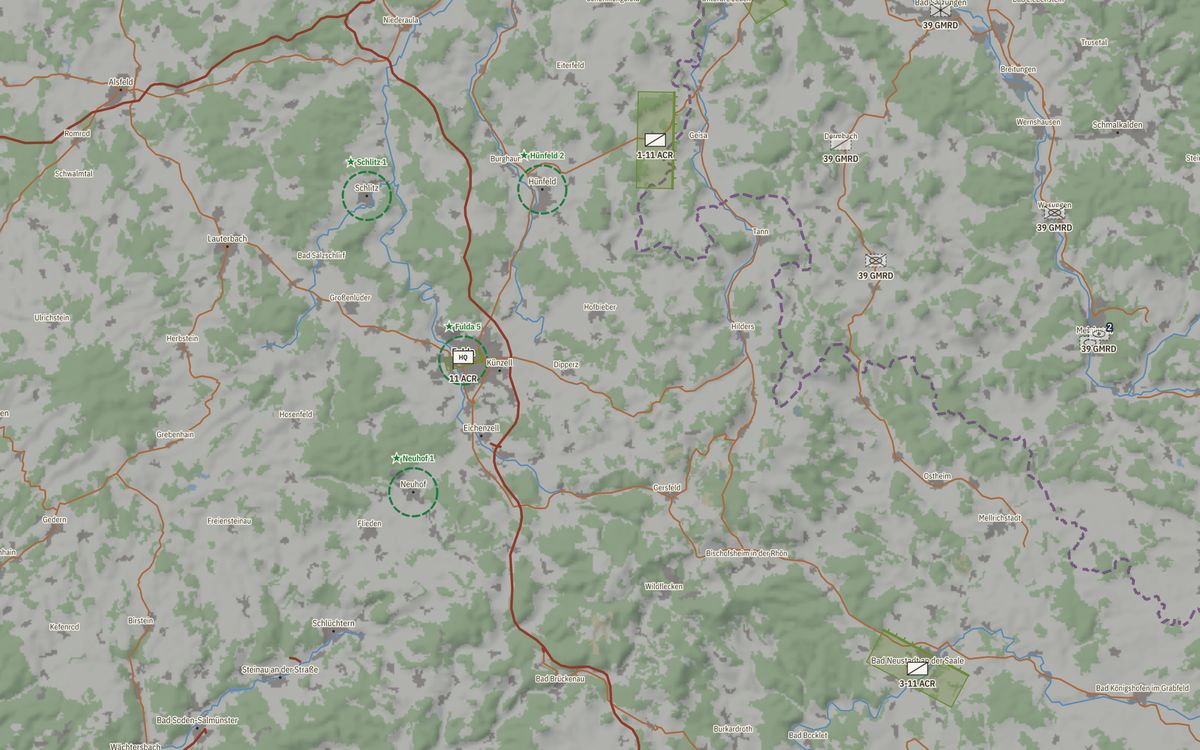
The Fulda region map from Kassel to Erlangen, showing forests, rivers, main roads, the inner German border, and unit markers on both sides.
The Scenario 1 map, from Kassel in the north to Erlangen in the south, with the inner German border in purple.

Real ground, and no hex grid

The rules run on the ground itself: positions in metres, the real road and rail network, rivers as lines, and bridges wherever a road crosses one. Forests, hills, towns and rivers change how attacks and defenses play out, and bridges are the chokepoints everyone fights over.

The full map runs from Mainz past Dresden and Nienburg to Nürnberg, about 412 by 430 km. It starts from public elevation, land-cover and river data, then is curated back to 1985: motorways by their opening dates, 1985 names such as Karl-Marx-Stadt, and the West Berlin boundary.

Eight scenarios, from a four-turn corps battle to a 60-turn campaign

Each scenario adds one or two systems. Each is planned to be playable from either side, solo, hotseat or by email.

The eight planned scenarios, their length, and their status
# Scenario Scope Turns Status
1 Fulda: The First Day V US Corps covering force against 8th Guards Army 4 Playable
2 Delay to the Weser One NORTHAG corps sector 8 Playable
3 Night of the Hinds Pact air assault on river crossings 6 Playable
4 Opening Air Operation Air-only, whole theater 4 Playable
5 The Second Echelon 1st Guards Tank Army commitment in CENTAG 12 In development
6 Jutland and Hamburg LANDJUT against the coastal axis 12 Planned
7 Northern Plain / CENTAG One army group, all systems 20 Planned
8 1985: Central Front The grand campaign 60 Planned

From the development log

Every expensive decision in the engine is written down. A few of them, in plain terms. A full dev log is coming.

We dropped the hex grid

The hex map’s errors grew with the map, so the rules moved to real geometry: positions in metres, the real road network, rivers as lines.

Decision D-063

The order of battle has sources

The ground order of battle is 67 formations and 391 units, each with a confidence and a source. Checking it found errors in our own Scenario 1, which are logged for correction.

Decision D-124

The AI is not there yet

Against scripted opponents, the AI meets our bar in 5 of 18 Scenario 1 matchups. The gaps are written down, and tuning waits until every system is in.

Decision D-121

About the studio

A reverse slope is the side of a hill facing away from the enemy, where a defender can wait out the fire and stay unseen.

Reverse Slope Games makes operational-level wargames on one reusable engine. Each title models a single war or theater. 1985: Central Front is first, and 1985: Northern Front is planned to follow.

Development news and release news only. Unsubscribe at any time. Privacy.

Questions

When does it come out, and what will it cost?

Neither is decided. Scenarios 1 to 4 are playable in development builds.

Which platforms?

Windows, Mac and Linux desktop builds are planned.

Can I play against another person?

Hotseat works today. Play by email is planned, with a sealed-orders handshake so neither side can peek. Direct control of a single brigade is solo-only.

Is it historical?

It is hypothetical: a war that never happened, built on researched 1985 order of battle, with a source and a confidence for every record. The units in the scenarios are still provisional.

Does the AI use a language model?

No. It is classical game AI that runs on your machine, offline, and plays under the same fog and order delays you do.